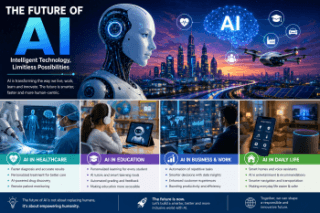
As for artificial intelligence, it is not just a topic from science fiction movies anymore. Artificial intelligence is now our reality; it influences all spheres of life, such as home activities, transport, and even business. Therefore, there is an urgent need to consider the future of artificial intelligence and its effect on society.
The purpose of the current article is to discuss the role of AI in healthcare, education, work, business, and other spheres. Moreover, some challenges and opportunities of this innovative technology will be analyzed.
What Is the Future of AI?
Artificial Intelligence, or AI, implies the ability of machines to learn, solve problems, understand language, and recognize patterns as humans do.
How Does AI Change Our Life Right Now?
Currently, AI is used in the functioning of search engines, recommendation algorithms, smart assistants, fraud detection mechanisms, etc. Besides, companies OpenAI and Google are developing AI that can write articles and even produce images.
As far as the operation of artificial intelligence is concerned, it lies in the processing of huge databases of information and searching for patterns. In some cases, machines perform faster than humans.
Why AI Is Developing at an Unprecedented Rate
There are three core factors driving AI growth:
Greater amounts of data
Faster computers and cloud computing
Improved machine learning algorithms
Thanks to such innovations, enterprises around the globe have been heavily investing in AI advancements.
The Past Behind the Future of AI
In order to grasp the direction AI is headed toward, we should learn about its history first.
From Computing Era to Intelligent Machines
The concept of AI emerged in the 1950s, when scientists realized that computers would eventually possess human-like cognitive abilities. Although these early devices had very limited capacities, they established a groundwork for future advancements in the field of machine learning.
Further progress in computing technology resulted in even better capabilities of intelligent machines.
The Key Landmarks of AI History
Several groundbreaking moments include:
Chess programs beating world champions at their own game
Speech recognition being introduced in phones
Development of self-driving vehicles by Tesla
Revolutionizing of communication technologies via AI language models
These developments have paved the way for the widespread use of AI in daily life.
The Future of AI in Healthcare
One area where AI technology shows great promise is healthcare.
Rapid Diagnosis and Improved Treatment
AI plays a crucial role in helping physicians diagnose diseases through scanning technologies and patient data. Some diseases can be detected faster by AI than conventional means.
AI applications include early detection of cancer, heart disease, and psychiatric disorders.
AI in Surgical Procedures and Health Monitoring
AI-powered robotic surgical systems help physicians conduct surgeries with precision. On the other hand, wearable health monitoring devices alert patients and their physicians to any health risks that may arise.
AI in Personalized Medicine and Medication Development
Through AI, personalized medicine can be developed. At the same time, AI makes drug development easier and faster by testing various chemical mixtures.
It can also result in saving money and lives.
The Future of Artificial Intelligence in Education
Education is evolving with the aid of AI.
Intelligent Classrooms and Personalized Learning
Artificial intelligence can recognize how children learn and tailor education accordingly. While some learners benefit from visual aids, others require hands-on practice.
AI enhances personalized education and effectiveness.
Virtual Tutoring and Learning Assistance
Virtual tutoring allows instant answers to students’ queries at any hour of the day. They enhance educational opportunities, particularly in distant regions.
Learning platforms based on AI can also facilitate foreign languages and exams.
Decrease in Teachers’ Workload
Teachers often devote substantial time to evaluating tasks and maintaining databases. Artificial intelligence could automate such processes and free up more time for instructors.
It translates into quality teaching and improved classroom interactions.
How to Start a Business in USA: 15 Powerful Steps to Launch Successfully
AI and the Future of Work
Many believe that AI will take away jobs. In reality, it is much more complicated.
Jobs to Be Transformed
Certain repetitive jobs might be automated, mainly in industries like manufacturing, customer service, and data entry.
Nevertheless, this doesn’t imply a decrease in employment in these sectors. Usually, it leads to reassignment of employees to other professions that demand creativity, management skills, and empathy.
Professions to Emerge Thanks to AI
Among such professions are:
- Data Science
- Cybersecurity
- Ethics in AI
- Robotics
- Machine Learning Engineering
Employees who will acquire new digital skills will have better career prospects for the future.
AI in Business of the Future
AI allows businesses to perform their functions quicker and more efficiently.
Automation and Improved Decision Making
Some examples of applications include automation of functions such as inventory management, planning, and customer care. Automation results in saving time and preventing errors.
The use of AI also enables an organization to understand the customer better to come up with better products.
Customer Care through Smart Chatbots
AI chatbots help in giving customers quick assistance. Chatbots provide answers to common questions and request made by customers.
This leads to growth in a business while lowering the cost of support services.
Using Predictive Analytics to Drive Growth
AI can predict sales trends and the requirements of customers. Predicting the future helps decision-makers base their actions on facts.
An organization will be in a favorable position when compared to its competitors.
Ethical Challenges to the Future of AI
Privacy and Data Security
AI requires massive amounts of data. Issues arise concerning privacy and how data is gathered and utilized.
Efficient security measures and sound policies must be put in place.
Human Bias, Discrimination, and Human Oversight
AI may incorporate human biases due to training on biased data. It can impact hiring, loans, criminal justice, and healthcare.
It is crucial that AI be ethically designed with human oversight.
Institutions such as UNESCO are still working to promote ethical AI standards globally.
AI in Daily Life
AI is already embedded in everyday life.
Home Automation, Transport, and Leisure
AI voice assistants operate home lighting and play music. GPS devices find quicker paths to destinations. Online services recommend films and TV shows.
AI enhances daily life through small improvements.
More Human-Like AI Assistants
Voice assistants and conversational agents are becoming more natural in their communication style. Future assistants will have a deeper understanding of emotions, preferences, and user behaviors.
This will result in the development of more useful technology.
Government and Regulation
Regulations are required to ensure that AI remains safe and ethical.
Importance of Regulations
In the absence of regulations, AI can be used in unethical ways, such as monitoring people and spreading disinformation.
Governments need to establish laws governing AI technologies to help innovators and protect individuals.
-
Creating Ethical AI Systems
Ethical AI systems will have these characteristics:
Transparency
Accountability
Fairness
Safety
Human-focused design
These tenets will guide the safe future of AI innovation.
Questions & Answers
- Will AI take over humanity completely?
Absolutely not; AI is meant to serve humanity, rather than supplant us entirely. Our capacity for innovation, empathy, and judgment remains crucial.
- In which sectors will AI make the most difference?
Some sectors that have been most impacted by AI include healthcare, education, finance, transport, and retail.
- Is AI harmful?
AI may be harmful when it is not developed according to proper guidelines. Responsible development minimizes these dangers.
- Can even smaller enterprises leverage AI?
Absolutely; numerous AI applications are available to support SMEs in areas like marketing, customer relations, and operations.
- What skills will matter in an AI era?
Skills like critical thinking, computer literacy, imagination, collaboration, and flexibility become increasingly significant.
Where can I find information about AI?
Resources such as MIT provide valuable information on current AI developments and trends.
Conclusion
Getting Ready for an AI-Driven Future
The future of artificial intelligence holds immense possibilities and promises great innovations. Artificial Intelligence can revolutionize medicine, education, business, and our everyday lives.
However, its success is based on how wisely we utilize it.
Artificial Intelligence should be created in such a way that it benefits us, promotes equity, and creates opportunities for all of us. The future of AI is not just about making technology smarter; it is about making the world smarter.
The future of AI is not waiting for us; it has already started.


