Hearing is an essential part of communication, learning, relationships, and everyday safety. From a baby responding to a parent’s voice to an older adult enjoying conversations with family, good hearing can significantly influence quality of life. However, hearing needs can change throughout life, and the right solution depends on age, hearing ability, lifestyle, and the underlying cause of hearing difficulty.
The World Health Organization (WHO) reports that more than 1.5 billion people worldwide live with some degree of hearing loss, and hearing loss can affect people at any stage of life. Early identification and appropriate intervention are important for better communication and development.
Whether you are looking for a Hearing Aid in Jaipur for an older family member, hearing support for a child, or professional hearing evaluation for yourself, choosing the right solution starts with an accurate hearing assessment.
At Hearing Healthcare Clinics, comprehensive hearing care includes hearing evaluations, hearing aids, speech therapy, and cochlear implant consultation, with personalized solutions based on individual needs.
Understanding Hearing Solutions at Different Ages
There is no single hearing solution that works equally well for everyone. A newborn, school-going child, working adult, and senior citizen may have completely different hearing requirements.
Some people may only need regular monitoring, while others may benefit from hearing aids, assistive listening technology, speech therapy, or cochlear implant evaluation.
The most important factors include:
- Age and stage of life
- Degree and type of hearing loss
- One or both ears affected
- Lifestyle and communication needs
- Speech and language development
- Comfort and ease of device use
- Medical history
- Budget and long-term care requirements
A professional hearing evaluation helps determine which option is appropriate.
Hearing Solutions for Newborns and Infants
Hearing plays an important role in early communication and language development. Babies learn by listening to voices, sounds, and their surroundings. If hearing loss is present and remains unidentified, it can affect speech and language development.
WHO recommends hearing screening and early identification for newborns and infants because timely intervention can help reduce the impact of hearing difficulties.
Common Hearing Solutions for Infants
Depending on the diagnosis, solutions may include:
- Newborn hearing screening
- Diagnostic hearing evaluation
- Regular hearing monitoring
- Pediatric hearing aids when appropriate
- Early intervention programs
- Speech and language therapy
- Cochlear implant evaluation for selected cases
For infants with significant hearing loss, parents should work closely with an audiologist and other healthcare professionals to create an individualized care plan.
Why Early Hearing Care Matters
Parents should not wait for a child to begin speaking before checking hearing. Early detection allows families and professionals to take appropriate steps during important stages of speech and language development.
Hearing Solutions for Toddlers and Preschool Children
Toddlers are rapidly developing speech, language, social skills, and learning abilities. Hearing difficulties may sometimes be mistaken for inattentiveness or delayed development.
Some signs parents may notice include:
- The child does not respond consistently when called
- Speech appears delayed
- The child frequently asks for repetition
- Difficulty following instructions
- Limited vocabulary compared with age expectations
- Turning the head toward sounds
- Increasing television volume
- Difficulty communicating in noisy environments
If these signs appear, a professional hearing assessment is recommended.
Hearing Aids and Speech Therapy
When hearing loss is identified, pediatric hearing aids may be considered depending on the child’s hearing profile. Hearing technology should be carefully fitted and regularly adjusted as the child grows.
Speech and language therapy may also be useful when hearing loss has affected communication development.
Hearing Healthcare Clinics provides both hearing care and speech therapy services, helping families address hearing and communication needs together.
Hearing Solutions for School-Age Children
School is an important stage for developing communication, concentration, academic skills, and social relationships. Even mild hearing difficulties can make it harder for a child to understand teachers, participate in group activities, or follow classroom discussions.
Recommended Hearing Support
Depending on the child’s hearing condition, solutions may include:
- Comprehensive hearing evaluation
- Hearing aid fitting when required
- Regular hearing-aid programming
- Speech and language support
- Classroom communication strategies
- Assistive listening technologies where appropriate
- Periodic hearing monitoring
WHO notes that children with hearing loss can benefit from appropriate assistive technologies, education support, and rehabilitation services.
Parents should also inform teachers about the child’s hearing requirements so classroom communication can be made easier.
Hearing Solutions for Teenagers
Teenagers are increasingly exposed to loud music, headphones, gaming, concerts, and other recreational noise. Excessive noise exposure can contribute to permanent hearing damage.
WHO highlights unsafe listening practices as an important preventable risk for hearing loss, particularly among young people.
Protecting Teen Hearing
Good hearing habits include:
- Keeping headphone volume at a safe level
- Taking listening breaks
- Avoiding prolonged exposure to loud music
- Using hearing protection in very noisy environments
- Getting a hearing test if symptoms develop
- Never ignoring persistent ringing or muffled hearing
If a teenager experiences difficulty hearing conversations, persistent tinnitus, or sudden changes in hearing, professional evaluation should not be delayed.
Hearing Solutions for Young Adults
Young adults may experience hearing difficulties because of noise exposure, ear infections, genetic factors, certain medications, injuries, or other causes.
People working in factories, construction, music venues, airports, or other noisy environments may have greater exposure to occupational noise.
The Right Solution for Young Adults
The appropriate solution depends on the hearing evaluation. Some people may only require hearing protection and regular monitoring. Others may require hearing devices.
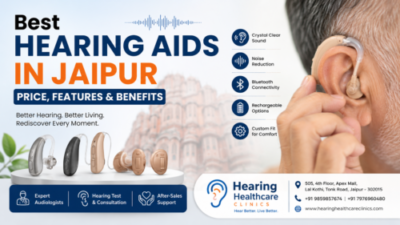
Modern hearing aids are no longer limited to simple amplification. Many digital models offer features such as:
- Noise reduction
- Bluetooth connectivity
- Smartphone compatibility
- Rechargeable batteries
- Automatic sound adjustment
- Personalized programming
Hearing Healthcare Clinics offers digital hearing aids with features including Bluetooth connectivity, noise reduction, rechargeability, and smartphone compatibility.
Hearing Solutions for Working Professionals
Hearing plays a major role in professional communication. Meetings, phone calls, presentations, workplace discussions, and online conferences can become challenging when hearing loss is not properly managed.
Professionals may particularly benefit from hearing technology that offers:
- Clear speech processing
- Background-noise management
- Bluetooth connectivity
- Smartphone integration
- Rechargeable operation
- Discreet designs
- Personalized sound settings
For someone considering a Hearing Aid in Jaipur, the best device should be selected based not only on hearing-test results but also on the person’s occupation, communication requirements, and daily environment.
For example, a teacher may need excellent speech understanding in classrooms, while a business professional may prioritize phone calls and meetings.
Hearing Solutions for Middle-Aged Adults
Hearing loss can develop gradually, making it easy to overlook. Many adults adapt by asking people to repeat themselves, increasing television volume, or avoiding noisy social situations.
These behaviors can be early signs of hearing difficulty.
WHO identifies symptoms such as difficulty understanding conversations in noisy places, frequently asking others to repeat themselves, increasing television volume, and difficulty hearing phone conversations as possible indicators of age-related hearing loss.
Why a Hearing Test Is Important
A hearing test can determine:
- Whether hearing loss is present
- The degree of hearing loss
- Which frequencies are affected
- Whether one or both ears are affected
- Whether hearing aids may be beneficial
If hearing loss is identified, appropriate intervention can make everyday communication easier.
Hearing Solutions for Senior Citizens
Hearing loss becomes more common with age. WHO reports that more than 25% of people over 60 are affected by disabling hearing loss.
Older adults may notice that speech sounds unclear even when they can hear that someone is talking. Conversations in restaurants, family gatherings, or crowded environments can become particularly challenging.
Common Signs of Hearing Loss in Seniors
- Frequently asking others to repeat themselves
- Increasing television or radio volume
- Difficulty following group conversations
- Trouble understanding speech in restaurants
- Missing doorbells or telephone sounds
- Speaking louder than usual
- Avoiding social conversations
- Complaining that people mumble
These symptoms should not simply be dismissed as a normal part of ageing.
Hearing Aids for Seniors
Modern hearing aids can provide personalized amplification according to an individual’s hearing profile. Depending on hearing loss and lifestyle, options may include:
- Behind-the-ear (BTE) hearing aids
- Receiver-in-canal (RIC) hearing aids
- In-the-ear (ITE) hearing aids
- Completely-in-canal (CIC) hearing aids
- Rechargeable digital hearing aids
Hearing Healthcare Clinics offers several hearing-aid styles and helps patients select devices based on hearing requirements, lifestyle, comfort, and budget.
Why Digital Hearing Aids Are Suitable for Many Age Groups
Digital hearing aids have changed the way people experience amplified sound. Instead of simply making every sound louder, modern devices can process sounds and adjust amplification according to different listening situations.
Important Features
Noise Reduction: Helps manage unwanted background noise.
Bluetooth Connectivity: Compatible devices can connect to smartphones and other supported electronics.
Rechargeable Batteries: Rechargeable models can make daily maintenance easier.
Automatic Sound Adjustment: Some devices can adapt settings according to the listening environment.
Smartphone Controls: Compatible apps can allow users to adjust selected hearing-aid settings.
Hearing Healthcare Clinics provides advanced digital hearing aids from globally recognized brands, including Signia and Widex, with options designed around individual hearing needs.
Choosing the Right Hearing Aid for Your Age and Lifestyle
Age alone should not determine which hearing aid you purchase. Two people of the same age can have very different hearing profiles and lifestyles.
Consider the following before selecting a device:
1. Get a Professional Hearing Test
A hearing aid should be selected based on your hearing assessment rather than simply choosing the most expensive model.
2. Consider Your Lifestyle
Think about where you spend most of your time. Do you attend meetings? Travel frequently? Spend time with family? Work in noisy environments?
3. Prioritize Comfort
A hearing aid needs to be comfortable enough for regular use.
4. Consider Device Features
Bluetooth, rechargeable batteries, noise management, and smartphone compatibility may be useful depending on your lifestyle.
5. Ask About Follow-Up Care
Hearing-aid fitting is not necessarily a one-time process. Follow-up appointments can help with programming, cleaning, maintenance, and adjustments.
Hearing Healthcare Clinics provides hearing-aid aftercare, including cleaning, tuning, software updates, repairs, and replacement of components when required.
Hearing Aids in Jaipur: What Should You Look For?
If you are searching for Hearing Aids in Jaipur, it is important to consider more than price.
A reliable hearing-care provider should offer:
- Professional hearing evaluation
- Experienced audiologists
- Multiple hearing-aid options
- Personalized fitting
- Trial and adjustment support
- Maintenance and servicing
- Guidance on device usage
- Long-term follow-up care
Hearing Healthcare Clinics provides hearing evaluation and personalized hearing-aid services in Jaipur. Its Jaipur clinic is located at Apex Mall, Lal Kothi, Tonk Road, and the clinic also has locations across multiple cities in Rajasthan.
Hearing Aids Are Not One-Size-Fits-All
A common misconception is that hearing aids simply make all sounds louder. Modern devices can be programmed according to an individual’s hearing profile.
For example, a person with mild high-frequency hearing loss may need a very different fitting from someone with severe hearing loss.
Similarly, a young professional who spends time in meetings may have different priorities from a senior citizen who primarily wants to hear family conversations and television more clearly.
This is why personalized hearing care is important.
When Should You Get a Hearing Test?
You should consider a hearing evaluation if you:
- Frequently ask people to repeat themselves
- Increase TV or phone volume
- Struggle to understand conversations in noisy places
- Have difficulty hearing on the telephone
- Notice ringing or buzzing in your ears
- Have trouble hearing alarms or doorbells
- Feel that people are mumbling
- Experience a sudden change in hearing
WHO recommends early identification and management of hearing loss, particularly for people at increased risk.
A hearing test is generally the best first step because it helps determine whether the problem is related to hearing loss and what type of support may be appropriate.
Beyond Hearing Aids: Other Hearing Solutions
Hearing aids are not the only option available.
Depending on the individual’s condition, hearing care may include:
Speech Therapy
Speech therapy can support children and adults who need help with speech clarity, pronunciation, language development, or communication skills.
Cochlear Implants
For certain individuals with severe hearing loss who receive limited benefit from conventional hearing aids, cochlear implant evaluation may be considered. WHO recognizes cochlear implants among assistive technologies that can help selected people with hearing loss.
Assistive Listening Technology
Additional assistive technologies may help people hear specific sounds more easily in certain situations.
The right solution depends on an individual’s hearing assessment and communication needs.
Hearing Healthcare for the Whole Family
Hearing care should not be limited to senior citizens. Hearing difficulties can affect babies, children, teenagers, adults, and older people.
A family-focused approach includes:
For babies: Early screening and timely intervention.
For children: Hearing assessment, appropriate devices, and speech-language support.
For teenagers: Noise protection and safe listening habits.
For adults: Regular hearing checks and workplace hearing protection.
For seniors: Hearing assessment, personalized hearing aids, and ongoing follow-up.
The goal is not simply to make sounds louder—it is to improve communication, confidence, independence, and participation in everyday life.
Why Choose Hearing Healthcare Clinics?
Hearing Healthcare Clinics focuses on comprehensive hearing care using professional evaluation, modern technology, and personalized support.
The clinic provides hearing tests, hearing aids, speech therapy, and cochlear implant services. It also has clinics across several Rajasthan cities, including Jaipur, Jodhpur, Udaipur, Ajmer, Alwar, Bikaner, Bhilwara, Sikar, and Sri Ganganagar.
The clinic emphasizes personalized evaluations and hearing solutions based on individual requirements rather than using the same approach for every patient.
For patients searching for a Hearing Aid in Jaipur, professional fitting and follow-up support can be just as important as the device itself.
Frequently Asked Questions
1. Can children use hearing aids?
Yes. Children with hearing loss may benefit from appropriately selected and professionally fitted hearing aids. The exact solution depends on the child’s hearing condition and developmental needs.
2. Are hearing aids only for senior citizens?
No. Hearing aids can be appropriate for people of different ages when hearing loss affects communication and daily activities.
3. How do I know which hearing aid is right for me?
A professional hearing test should be the starting point. Your audiologist can consider your hearing level, lifestyle, comfort preferences, and budget before recommending suitable options.
4. Are modern hearing aids difficult to use?
Many modern digital hearing aids are designed to be user-friendly and may include automatic adjustments, rechargeable batteries, and smartphone controls. Hearing Healthcare Clinics also provides guidance for using and maintaining hearing devices.
5. Can hearing aids restore normal hearing?
Hearing aids do not cure the underlying cause of hearing loss. They are designed to improve access to sound and communication for people who can benefit from amplification.
6. How often should hearing be checked?
The appropriate frequency depends on age, symptoms, risk factors, and medical history. People noticing changes in hearing should seek a professional evaluation rather than waiting for the problem to become severe.
Final Thoughts
The best hearing solution is the one that matches the person’s age, hearing condition, lifestyle, communication needs, and long-term goals.
From newborn screening and pediatric hearing support to advanced digital hearing aids for adults and seniors, hearing care should be personalized at every stage of life. Early identification is important because untreated hearing difficulties can affect communication, learning, work, relationships, and overall quality of life.
If you are looking for Hearing Aids in Jaipur, start with a professional hearing evaluation rather than choosing a device based only on appearance or price. A qualified audiologist can help identify your hearing needs and recommend an appropriate solution.
Hearing Healthcare Clinics provides comprehensive hearing care, including hearing evaluation, digital hearing aids, speech therapy, and cochlear implant services.
Better hearing can mean better communication, greater confidence, and a more connected life—at every age.
Contact Hearing Healthcare Clinics
Hearing Healthcare Clinics – Jaipur
505, 4th Floor, Apex Mall, Lal Kothi, Tonk Road, Jaipur – 302015, Rajasthan
Phone: +91 9859857674 / +91 7976960480
Email: [email protected]
Website: Hearing Healthcare Clinics
This article is for general educational purposes and does not replace an individual hearing evaluation or medical advice from a qualified healthcare professional.


