AI tools have quickly become part of everyday life for many teenagers. From answering questions and helping with homework to creating stories and exploring new ideas, AI chatbots can be useful and fun. But as teens spend more time with these tools, it is also important to understand what happens when they share personal information with AI.
AI privacy for kids is not about telling teenagers to avoid AI completely. It is about helping them understand what information should stay private and why being careful online matters. A simple rule can help: if something is too personal to share with a stranger online, it is probably better not to share it with an AI chatbot either.
Why AI Privacy Matters for Teenagers
Teenagers often use AI casually. They may tell a chatbot about a problem at school, ask for advice about friendships, or share details while trying to get a more personalized answer.
The problem is that young users may not always think about where their information goes after they enter it. Different AI apps have different privacy practices, and some may store conversations or use data in ways users do not immediately understand.
That is why teen online privacy should be part of everyday digital safety. Teens don’t need to fear AI, but they should learn to pause before sharing something personal.
What Personal Information Should Teens Never Share With AI?
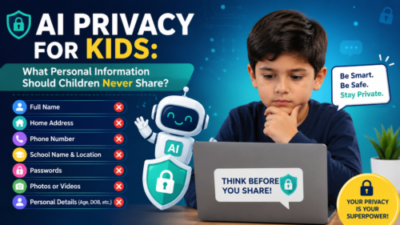
Some information is best kept private, even when a chatbot seems friendly or helpful. Teens should avoid sharing details such as:
- Full home address
- Personal phone number
- Passwords or login information
- School account details
- Bank or payment information
- Government identification numbers
- Private information about family members
- Real-time location or daily routines
- Information that could be used to identify or contact them offline
It is also a good idea to avoid sharing highly personal stories that could cause problems if someone else sees them.
For example, a teen can ask an AI for general advice about friendship problems without giving the names, school, address, or other identifying details of the people involved.
Can AI Chatbots Remember Teenagers’ Conversations?
This is one of the most important things for young users to understand about AI chatbot safety.
Not every AI app handles conversations in exactly the same way. Depending on the service and its settings, chats may be stored, reviewed, used to improve the service, or connected with account information. Some AI tools may also offer memory features that allow them to remember certain details across conversations.
Because privacy policies and settings can differ, teenagers should not assume that typing something into a chatbot means it will disappear immediately after the conversation ends.
Before using an AI app, it is worth checking its privacy settings and understanding what information it collects and how it handles conversations.
Risks of Sharing Private Photos and Sensitive Information
Photos can reveal more than a teenager may realize. A picture might include a school uniform, street sign, house number, location information, or other details in the background.
The same applies to sensitive information shared through text. A teen might mention their full name, school, family situation, or personal problem without realizing that several small details can be combined to identify them.
AI tools can also edit or create images, so teens should think carefully before uploading personal photos. A safer approach is to use general examples or remove identifying details whenever possible.
If an AI tool does not need a personal photo or private detail to answer a question, there is usually little reason to provide it.
How AI Apps Can Affect Teen Privacy
AI apps can collect different types of information depending on how they work. This may include account details, conversations, device information, or other usage data.
The privacy practices can also vary from one app to another. An AI chatbot designed for schoolwork may handle information differently from a social AI app or an entertainment-focused platform.
This does not mean every AI app is unsafe. It simply means teens should develop the habit of checking an app before trusting it with personal information.
Reading the privacy section, checking account settings, and understanding what information an app requests are small steps that can make a meaningful difference.
Privacy Rules Parents Should Teach Their Kids
Parents do not need to create complicated rules around AI. A few simple habits, along with the right parental control tool, can make privacy easier for teenagers to understand.
First, teach them to think before they share. If an AI chatbot asks for information that isn’t necessary to answer the question, they can omit it.
Second, remind them never to share passwords or account details with an AI chatbot. The same rule applies to sensitive information belonging to friends or family members.
Parents can also encourage teenagers to use general examples instead of real names and personal details. For instance, instead of writing about a specific classmate, they can simply say “a friend from school.”
Most importantly, keep the conversation open. Teens are more likely to talk about privacy concerns when they know they can ask questions without getting in trouble right away. Parents can also use parental controls to support these conversations and help create safer digital habits without completely invading their teenager’s privacy.
How to Help Teens Use AI More Safely
Safe AI use is mainly about building good habits, not avoiding technology.
Encourage teenagers to check an AI app’s privacy settings before using it regularly. They should also avoid connecting unnecessary personal accounts and should review what information the app requests.
It is also helpful to remind them that AI can make mistakes. A chatbot may sound confident even when its answer is incorrect, so personal decisions should not always be based on an AI response.
Parents can occasionally discuss the AI tools their children use, what they use them for, and whether they have noticed anything that makes them uncomfortable. This creates a healthier approach to digital safety than simply banning every new technology.
Final Thoughts on Teen Privacy and AI
AI can be a useful part of a teenager’s digital life, but privacy should remain part of the conversation. Teens should understand that they don’t need to share every detail just because an AI chatbot asks for it.
Keeping passwords, contact details, precise locations, private photos, and other sensitive information out of AI conversations is a good starting point. Parents can support this by teaching simple privacy habits and keeping communication open.
The goal is not to make teenagers afraid of AI. It is to help them become more thoughtful about what they share, which is an important skill for using almost any online service safely.


