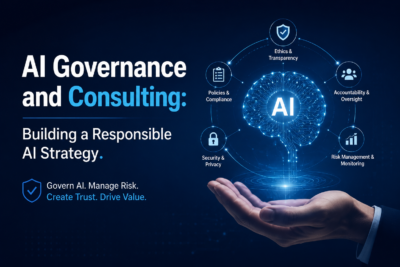
Every business rushing to deploy AI eventually hits the same wall: it works, but nobody can explain why it made a specific decision, who’s accountable if it’s wrong, or what happens when a regulator asks. That wall is what AI Governance and Consulting exists to prevent, not fix after the fact.
This post lays out what a responsible AI strategy looks like in practice, the pillars it rests on, and the steps to build one before governance becomes a crisis rather than a plan.
Why Responsible AI Strategy Can’t Be an Afterthought
Most companies treat governance as paperwork to handle only after the AI system is live. That order is backward. Retrofitting oversight onto a deployed model means auditing decisions you can no longer fully explain, and fixing bias after it’s already shaped outcomes for real customers.
A responsible strategy built early does three things a bolt-on policy can’t:
- Catches data quality and bias issues before they reach production
- Gives leadership a clear answer when asked: “Who approved this system?”
- Reduces the cost of compliance, since rework is always more expensive than upfront design
What “Responsible AI” Actually Means (Beyond the Buzzword)
Strip away the marketing language, and responsible AI comes down to a simple test: can you explain what your system did, why it did it, and who’s accountable for the outcome? If the answer is no, governance isn’t in place yet, no matter how sophisticated the model is.
This is the gap that formal AI governance solutions are built to close, turning vague good intentions into documented, repeatable processes.
The Core Pillars of a Responsible AI Strategy
Accountability and Ownership
Every AI system needs a named owner, not a committee. That person signs off on deployment, reviews flagged outputs, and is the point of contact when something goes wrong. Without this, accountability quietly disappears the moment a problem surfaces.
Data Privacy and Security
AI systems are only as trustworthy as the data behind them. This pillar covers:
- What data can the system access, and under what consent
- How long data is retained and where it’s stored
- Who can view raw inputs versus just model outputs
Bias Detection and Fairness
Bias doesn’t announce itself. It shows up as a hiring model that quietly favors one demographic, or a pricing tool that treats similar customers differently. Responsible strategy requires testing outputs against protected categories on a set schedule, not just at launch.
Transparency and Explainability
Stakeholders, whether they’re customers, regulators, or your own executive team, need to understand model decisions in plain language. This doesn’t mean exposing every technical detail. It means having a clear, honest explanation ready when someone asks how a decision was made.
Continuous Monitoring
Models drift. Data changes. A system that was fair and accurate at launch can degrade quietly over months. Ongoing monitoring, not a one-time audit, is what keeps governance real instead of theoretical.
Building the Strategy: A Step-by-Step Approach
Step 1: Assess Current AI Maturity
Before writing any policy, map what AI you’re already using, officially or otherwise. Shadow AI, tools individual teams adopted without central approval, is one of the most common governance gaps.
Step 2: Define Governance Roles
Assign clear ownership: who approves new AI use cases, who monitors performance, and who has authority to shut a system down if it misbehaves. Vague ownership is the single biggest reason governance policies fail in practice.
Step 3: Set Policy Before Scaling
Write down acceptable use cases, data handling rules, and review cadence before rolling AI out company-wide. Policies written after widespread adoption tend to describe existing bad habits rather than prevent them.
Step 4: Choose the Right AI Consulting Partner
Not every business has the in-house expertise to build this from scratch, and that’s where external AI Consulting Services earn their keep. A capable artificial intelligence consulting partner brings frameworks that have already been stress-tested elsewhere, so you’re not reinventing governance from a blank page.
Step 5: Build in Review Cycles
Governance isn’t a document you file away. Quarterly reviews of model performance, policy relevance, and incident logs keep the strategy tied to how the business actually operates, not how it operated a year ago.
Common Mistakes Businesses Make with AI Governance
- Treating governance as a legal checkbox instead of an operational discipline
- Copying another company’s policy without adapting it to their own data and risk profile
- Assigning governance to IT alone, when it needs input from legal, operations, and business leadership
- Skipping documentation because “the team just knows how it works,” until that team turns over
- Waiting for a regulator or incident to force the first real governance conversation
How AI Governance and Consulting Work Together
Governance defines the rules. Consulting helps you apply them correctly to your specific business, industry, and risk exposure. Trying to separate the two often produces policies that look good on paper but don’t match how the business actually uses AI day to day.
This is why serious AI consultation engagements now build governance into the strategy phase itself, rather than treating it as a separate workstream that gets attention only after something breaks.
Signs You Need External AI Governance Services
Internal teams can handle basic governance, but certain signals point to bringing in outside expertise:
- Your industry has specific regulatory requirements you don’t fully understand yet
- AI use has scaled faster than your policies have kept up with
- A previous AI incident exposed gaps nobody had planned for
- Leadership can’t clearly answer who owns AI decisions across the company
In any of these cases, working with a firm that offers dedicated AI governance services isn’t overkill. It’s the difference between a strategy that holds up under scrutiny and one that only looks good until someone asks the wrong question.
A responsible AI strategy isn’t built in a single meeting or a single document. It’s built through clear ownership, honest documentation, and a willingness to revisit the plan as the business and the technology both keep changing.


